


A Threshold of Forced Maturation
In astrology, there are moments when we are not merely witnessing shifts in tone or rhythm, but profound paradigm changes. Conjunctions between slow-moving planets mark such historical thresholds—periods in which old forms and structures dissolve, while new ones begin to emerge, still unstable and poorly defined.
The year 2026 stands as one of these pivotal moments. After an extended phase of transition, uncertainty, and symbolic oscillation, Saturn and Neptune will firmly establish themselves in Aries, culminating in their exact conjunction on February 20, 2026. This alignment inaugurates a new 36-year synodic cycle, with both planets positioned at the very first degree of the zodiac—a fact of exceptional symbolic weight.
This conjunction is not an isolated astrological event. It signals a deep reorganization of collective reality itself. To understand the implications of this new cycle, we must first examine the broader astrological and historical context in which it emerges.
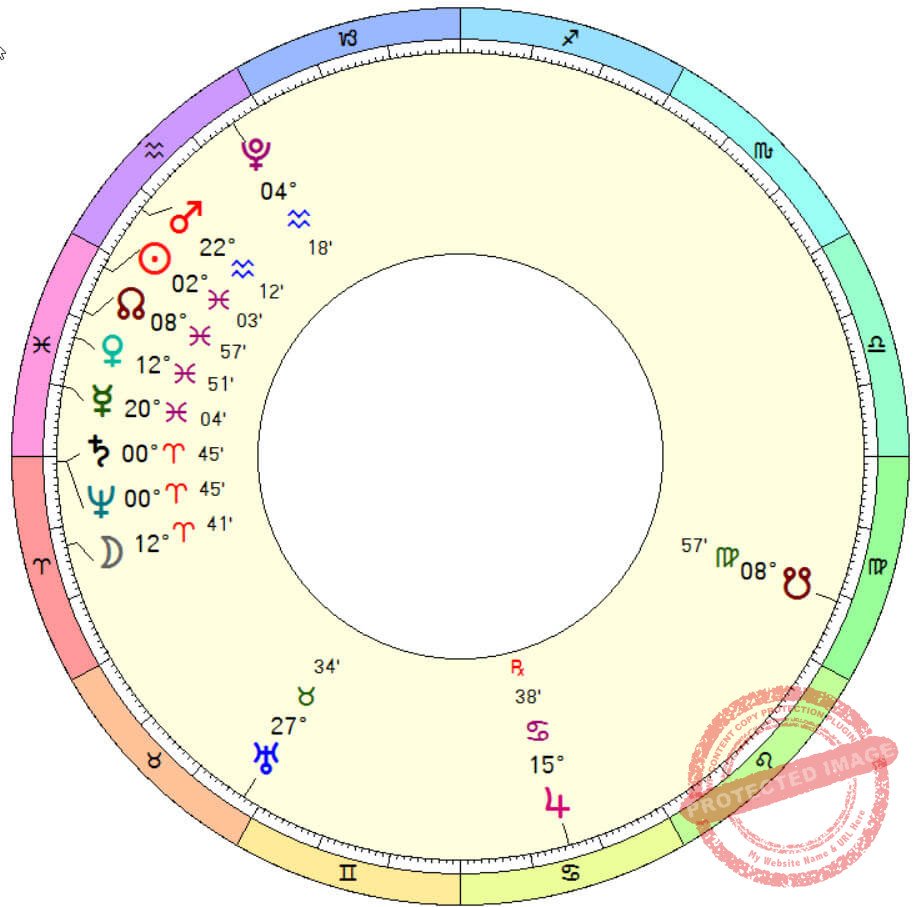
Table of Contents
The Astrological Context of the Saturn-Neptune Conjunction
The year 2025 unfolds under intense collective pressure. Looking retrospectively, it represents a period in which the tension between decaying structures and emerging paradigms becomes impossible to ignore. The struggle between chaos and innovation, dissolution and reconstruction, defines the atmosphere of the time.
This tension mirrors several dominant astrological signatures:
- Pluto in early Aquarius
- Uranus completing its transit through Taurus
- Persistent strain between Saturn and Jupiter
- The oscillatory movement of slow planets—Saturn, Uranus, and Neptune—across sign boundaries
If 2025 is a year of revelation, those revelations are rarely comfortable. They expose the fragility of systems long assumed to be stable, our dependence on vulnerable infrastructures, and the real costs of accelerated progress. At the same time, this context tests the collective capacity for adaptation amid political, economic, and social turbulence.
With Saturn and Neptune transiting Pisces, symbolic and moral confusion intensifies. Distinctions once perceived as clear—between responsibility and innocence, aggressor and victim—become blurred within public discourse. Collective narratives tend to dissolve individual accountability, while ideological slogans function as moral camouflage, masking contradictions and unacknowledged interests.
This dissolution of clear evaluative criteria explains why the transition into the Saturn-Neptune cycle in Aries will be experienced not as a smooth passage, but as a sharp rupture. The new synodic cycle begins at the very first degree of the zodiac—a fact profoundly significant for the entire 36-year period it covers. This is, without doubt, the most important astrological event of 2026 and one of the most significant of this decade.
“The Saturn-Neptune conjunction in Aries marks not a smooth transition, but a sharp rupture—a threshold where old certainties dissolve and new paradigms struggle to take form.”
Saturn-Neptune Cycles: Between Realism and Utopia
To understand what the merging of these two principles—Saturnian and Neptunian—symbolizes, and how they have interacted throughout history, we must first clarify their archetypal meanings:
- Saturn represents form, structure, law, responsibility, hierarchy, and concrete order.
- Neptune dissolves boundaries, undermines forms, generates ideals, myths, collective dreams, and illusions.
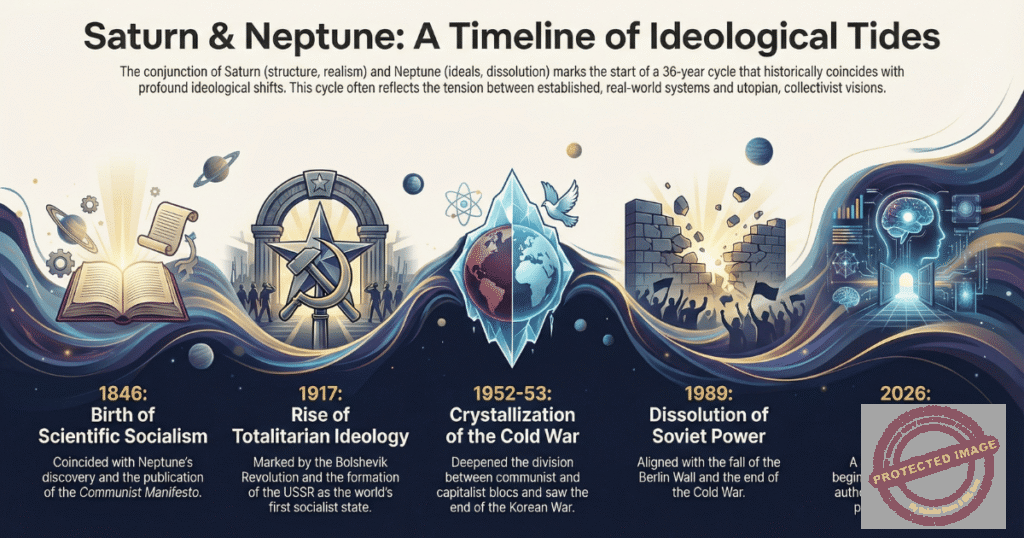
Since Neptune’s discovery in September 1846—the moment its significations entered collective consciousness—humanity has experienced only four Saturn-Neptune synodic cycles. This is a limited sample, yet one marked by a consistent underlying theme that will very likely constitute the essential imprint of the coming cycle.
Historical Precedents: Four Cycles of Transformation
1. The Discovery Conjunction (1846): Birth of Scientific Socialism
Remarkably, Neptune was discovered at the moment of its partial conjunction with Saturn in Aquarius. Shortly thereafter, in 1848—a year animated by numerous revolutions (though most were suppressed) aimed at obtaining civil liberties, national unity, and political reforms—Karl Marx published the Communist Manifesto, the fundamental programmatic document of scientific communism. This document analyzed the mechanisms of capitalism and proposed a major social transformation. The presence of a utopian socialist perspective is evident in this context.
2. The Bolshevik Revolution (1917): Autocracy to Totalitarian Ideology
The next Saturn-Neptune conjunction in 1917 marked the Bolshevik Revolution and the transition from an autocratic empire to an ideological totalitarian state. This was another key event in the tumultuous relationship between the system of natural order and that of social utopia. Shortly thereafter, the USSR became the world’s first socialist state and eventually a global superpower.
3. The Cold War Crystallization (1952-1953): Polarization and Division
The conjunction of 1952 occurred amidst significant polarization between two opposing tendencies. Globally, the separation between the communist and capitalist blocs became even more evident then, with 1953 (when the conjunction was still very active) marking the end of the war between North and South Korea.
4. The Fall of the Berlin Wall (1989): Dissolution of Totalitarian Structures
Finally, the last Saturn-Neptune conjunction (which occurred in the conservative sign of Capricorn at the end of 1989) coincided with the fall of many totalitarian structures of the communist bloc and the end of the Cold War.
The Fundamental Theme: Natural Order vs. Utopian Vision
Therefore, the significance of this cycle is not necessarily linked to the affirmation of leftist political currents, but rather to the oscillating relationship between two orientations: the realist and the utopian. The Saturn-Neptune synodic cycle reflects the connection between:
- What we might call the “natural system” characterized by hierarchy, control, authority, structure, clear rules, private property, pragmatism, competition, conservative tendencies, slow progress, meritocracy (“the Law of the Father” or Patriarchy), and
- Utopian, collectivist tendencies marked by the aspiration to dissolve boundaries between different categories, common property, the ideal of equality and unity, loss of individuality in the collective mass (“the Law of the Mother”).
Historically, this cycle has manifested as the ideological conflict between capitalism and communism. However, on a deeper level, it refers either to the undermining of overly conservative, rigid systems or to failed attempts to crystallize and systematize certain idealistic social currents or totalitarian doctrines. Experience so far has demonstrated that in the new cycle, we will witness a new utopian system and, simultaneously, the dissolution of an already existing rigid order.
The Saturn-Neptune conjunction marks a crisis of meaning and legitimacy, which translates into the dissolution of forms, the weakening of structures, and the erosion of existing systems. When these two principles meet, history enters a zone of structural ambiguity: what seemed solid begins to unravel, while what was vague attempts to take form. Moreover, Saturn-Neptune brings not so much the collapse of existing forms and structures, but rather their emptying of significance.
Saturn-Neptune in Aries: A Volatile Union
This conjunction is particularly unstable because it occurs in Aries, a sign inhospitable to both principles. Their union is especially delicate as we are dealing with two antagonistic principles forced to unite in a sign that is not friendly to either of them.
- Saturn in Aries, in detriment, struggles to impose discipline where constraint is rejected. Its caution and restrained approach clash fundamentally with Aries’ impetuous and explosive drive.
- Neptune in Aries—a planet of collective feeling “lost” in an individualistic sign—inflames idealism and collective emotion, producing militant visions without stable form, feeding confusion, radicalization, and contradictory impulses.
The result is not harmony, but explosive tension with potentially destructive outcomes: a crisis of will, authority, identity, and direction. Old structures are no longer recognized as legitimate, yet no new framework has been fully established. It is a crisis of identity, form, and direction.
A Dream World—But Not the One You Imagined
The Saturn-Neptune conjunction in Aries carries a profound ideological and philosophical dimension, oriented toward transforming the perception of reality itself. Amplified by Pluto in Aquarius, it signals not merely political change, but a redefinition of reality itself.
We are not witnessing just political shifts, but a reconfiguration of how we define the real and the legitimate. The world is not merely interpreted differently; it is actively remodeled based on concepts that, until recently, would have been considered speculative or marginal.
Previously stable categories begin to dissolve. Concepts once considered speculative or marginal are asserted with surprising intensity. Under Aries’ influence, Neptune’s fluidity is not passive—it becomes activist, confrontational, and often aggressive. Many ideas—even if profoundly unfounded—are no longer negotiated; they are proclaimed, imposed, or defended as expressions of an identity struggling for legitimacy.
Traditional institutions, ideologies, and symbolic authorities lose their gravitational pull. In their place emerge emotionally charged narratives—fragmented, contradictory, yet powerfully mobilizing. Social and political life increasingly resemble an open arena where experimental ideas are directly tested in real life, bypassing gradual validation.
Spirituality retreats from institutional forms and becomes individualized, syncretic, and pragmatic—an attempt to reclaim meaning amid ideological instability.
The Realist and the Surrealist: Living Inside the Dream
From a symbolic perspective, Saturn represents the Realist, focusing on functionality, limits, and verification over time. In contrast, Neptune embodies the Surrealist, characterized by the dissolution of boundaries, radical imagination, and dreams that challenge established forms. Their union places us in a transitional space where distinguishing between the real and the unreal becomes increasingly difficult.
If classical surrealism was a dream contemplated on a canvas or in a text, the Saturn-Neptune conjunction marks the moment when we wake up trapped inside the dream. In Aries, the individual is not merely a spectator but a pioneer, fighter, or explorer, compelled to navigate the unknown territory of “dream reality” to define themselves.
This configuration introduces a fundamental dilemma with major social implications: How do we evaluate the real potential of a situation and distinguish between what is possible and what is purely illusory when clear criteria do not exist?
Artificial Intelligence and the Crisis of Cognitive Authority
These transformations unfold against the backdrop of an unprecedented explosion of technological innovation, particularly in the fields of artificial intelligence and large language models, which are already introducing a series of paradoxes and major dilemmas into our collective life.
We are beginning to accept, often without deep reflection, that complex decisions—in medicine, law, finance, and security—are (and will increasingly be) delegated to opaque systems whose internal logic escapes human intuition. Authority is transitioning from human judgment to being mediated by algorithms.
AI models exhibit emergent abilities not explicitly programmed, resembling cognitive processes previously associated only with the human mind: contextual reasoning, creative synthesis, anticipation, and the generation of coherent meanings. This emergence of “mental” functions from artificial systems calls into question traditional boundaries between instrument and agent, between technology and consciousness, between control and autonomy.
The Astrological Symbolism of AI Emergence
Astrologically, this dynamic can be understood through the symbolism of the Saturn-Neptune conjunction:
- Saturn symbolizes the material and logical framework of the world: artificial systems, hardware, networks, physical and biological structures, and the limitations that enable functioning.
- Neptune symbolizes the dissolution of boundaries, trans-individual consciousness, virtual reality, and the emergence of fields of meaning that can no longer be located in a singular subject.
Their union produces material structures generating immaterial effects, rigid systems giving rise to fluid, almost “living” behaviors. This is not mere automation, but the emergence of functional pseudo-consciousness, challenging classical humanist categories.
The placement of this conjunction in Aries radicalizes the process. Aries does not contemplate, mediate, or wait for consensus; it inaugurates, forces, and opens paths through direct action. Thus, Saturn-Neptune in Aries does not describe a slow and negotiated transition, but a leap—an abrupt beginning of a post-humanist era, in which humanity ceases to be the measure of all things.
Brain-computer interfaces, virtual reality, cognitive augmentation, and the delegation of decisions to non-human systems have become central themes, not as theoretical possibilities but as operational realities.
The Danger of Moral Abdication
The major danger of this period does not consist in the development of artificial intelligence itself, but in humanity’s growing willingness to abdicate its own moral responsibility under the pretext of efficiency, neutrality, or algorithmic objectivity. The greatest danger is not AI itself, but the voluntary abdication of moral responsibility in the name of efficiency and algorithmic neutrality.
When decisions are externalized and accepted without understanding, individual freedom is eroded not through coercion, but through convenience. Under Neptune’s influence, this renunciation can be justified through noble ideals—the common good, safety, resource optimization—while Saturn continues to maintain the appearance of order and functionality.
In this context, the risk arises from an impersonal form of authority—one that is difficult to challenge because it lacks a visible face, a discernible intention, or a clearly identifiable will. Thus, Saturn-Neptune in Aries warns of a dangerous paradox: a world in which decisions are firm but responsibility is diffuse; in which order is maintained but the sense of responsibility disappears.
Saturn-Neptune in Aries marks the moment when artificial structures not only support our existence but begin to compete with us for the role of cognitive and decisional agents.
Economic Instability and the Illusion of Control
The Saturn-Neptune cycle is inherently unstable for economic systems because economies will confront major influxes of novelty (associated with the impulses and explosive drive of Aries) for which their structures have not been fully prepared. New and complex directions of development appear, and old systems (symbolized by Saturn) will pass through major crises of renewal and adaptation.
Although the conjunction of the two planets is not usually reflected in sudden and clearly identifiable shocks, but is expressed through slow dissolutions, structural ambiguities, and systemic confusions, nevertheless, in Aries, these adaptation and reconfiguration processes are accelerated, forced, and often pushed to breaking points through impulsive decisions, aggressive investments, and economic policies oriented toward quick solutions.
Immediate Economic Manifestations
As immediate effects, we can expect:
- The collapse of artificially sustained financial bubbles
- Abrupt revaluations of real and financial assets
- Persistent inflationary pressures or recurring returns of inflationary pressures
- Acceleration of the disappearance of physical money and expansion of digital currencies
- The proliferation of complex speculative schemes, difficult for the general public to understand
- Aggressive economic decisions motivated by impulsiveness and utopian promises
Responsibility for failure is rarely assumed directly. Blame diffuses into abstractions—markets, crises, external forces. Characteristically Neptunian, responsibility/blame for catastrophic failures will rarely be directly assumed.
Natural Resources and Energy
When it comes to resource exploitation, this conjunction highlights a tension between control and waste, intensified by idealized narratives surrounding the green transition, which are likely to be aggressively promoted through ambitious, large-scale projects that remain insufficiently tested from an economic standpoint.
There is a risk that “green energy” may function, at least partially, as a Neptunian mirage: a salvific promise that masks high real costs, new dependencies on critical resources, and financial schemes difficult to sustain long-term.
Real Estate Market: Property, Fear, and Painful Corrections
The real estate market directly reflects the tension between Saturn and Neptune. Saturn emphasizes property, security, stability, and tangible value, while Neptune has fueled in recent years the illusion of continuous growth, detached from real economic fundamentals. In Aries, this contradiction may lead to sudden corrections, particularly where prices have been artificially influenced by speculation, excessive lending, or lenient monetary policies.
Financial-Banking System: Complex but Very Risky Schemes
In the financial and banking system, the new cycle will lead to the gradual disappearance of cash, the expansion of central bank digital currencies, and the growing complexity of financial products. Saturn demands safety and stability, but Neptune undermines transparency, favoring opaque financial products, tax optimization schemes at the edge of legality, and an ever-greater distance between the real and financial economies.
Pensions, Savings, and Erosion of the Social Contract
The area of pensions and long-term savings is particularly sensitive. Saturn represents the contract between generations, signifying the promise of stability and security for individuals at the end of their working lives. In contrast, Neptune introduces uncertainty and tacit renegotiation of these promises. When in Aries, the pressure intensifies, leading to issues such as underfunded pension systems, hastily implemented reforms, and a shift of responsibility from the state to individuals.
The Crisis of Property Rights in an Unstable World
Saturn signifies, par excellence, property, delimitation, legitimate possession, and its administrators. Neptune, by its nature, erodes these certainties. It reexamines the idea of possession, introducing ambiguity and shifting it into virtual or symbolic realms.
A key area of this cycle is digital and intellectual property. The combination of Neptune, symbolizing the virtual realm, with Saturn necessitates a thorough reevaluation of traditional concepts regarding authorship, ownership, and control.. The emergence of artificial intelligence, the infinite reproduction of content, and the virtualization of assets challenge the conventional boundaries of property.
From this perspective, the economic lesson of the Saturn-Neptune conjunction in Aries emphasizes the necessity for forced maturation. This entails a realistic reassessment of risks, a clearer understanding of market promises, and a greater assumption of individual responsibility in an environment where collective guarantees are becoming increasingly fragile.
Geopolitics: Confrontation Without Clarity
At the geopolitical and military level, events in recent years have already created a profoundly unstable climate, characterized by insecurity, lack of strategic coherence, and erosion of trust in traditional collective security mechanisms.
The new Saturn-Neptune cycle emphasizes these tendencies, particularly because it begins in Aries—a sign associated with confrontation, impulsive action, and a refusal to compromise. Aries does not negotiate—it confronts. Diplomacy is weakening, strategic patience is eroding, and decisions are made quickly, often without careful evaluation of the consequences.
We already see clear manifestations of this dynamic:
- Increasingly visible fissures in political and military alliances considered solid until recently
- Increasingly evident lack of security guarantees from guarantors at the international order level
- Countries forced to rethink their defense strategies (but many blocked by bureaucratic inertia)
- Major vulnerabilities in defense systems previously considered almost impenetrable
Saturn in Aries indicates hasty actions driven by fear and insecurity. Neptune in Aries brings about strategic confusion and unrealistic aspirations. The combination of Saturn and Neptune in Aries poses significant risks to global stability.
In this context, we will witness:
- Much unjustified adversity
- Difficulty in correctly evaluating adversaries’ intentions
- Hasty military decisions, unexpected attacks, or preventive attacks
- Local or regional conflicts with disproportionate effects at the global level
- Violent or subversive contestation of existing power structures
- Militarization of identity and ideological discourses
- Conflicts that are no longer fought for clear strategic objectives.
The greatest risk lies in strategic bluffing—projecting strength to compensate for underlying weakness. In a climate of mistrust, such gestures can trigger uncontrollable escalation. The danger of a regional or even global conflagration is extremely great in 2026 and in subsequent years! This period can easily become one of collective suffering.
The New Iron Curtain: Territorial Integrity and Mass Migrations
In light of these tensions, the emergence of a new iron curtain seems possible. However, this division may not take the traditional form of an ideological split. Instead, it could manifest as a separation of countries into new, antagonistic blocs driven by their own strategic interests and economic constraints.
At the geopolitical level, Saturn governs territories, borders, sovereignty, and the state’s capacity to administer and defend them. Neptune undermines these structures through ambiguity, propaganda, identity mythologies, and contestation of historical or legal legitimacy.
Aries, a sign of conquests, migrations, and direct conflict, is profoundly unstable for territorial integrity. The Saturn-Neptune conjunction in Aries indicates:
- Contestations of existing borders
- Attacks on territorial integrity
- Territorial losses or cessions, seizures under military, economic, or political pressure
- Major difficulties in obtaining durable legal agreements
- Use of historical or identity myths to justify aggressive actions
Mass migrations exacerbate this tension. Wars, natural disasters, epidemics, and economic imbalances lead to population displacements that exert direct pressure on the territories of destination states.
In the era of Saturn-Neptune in Aries, the true geopolitical challenge is not the accumulation of armament or demonstration of force, but the capacity to maintain lucidity, discernment, and responsibility in a climate dominated by fear and impulse. Without these, the order Saturn tries to conserve can be destroyed precisely by the means meant to defend it.
The danger of a regional or even global conflagration is extremely great in 2026 and subsequent years. This period can easily become one of collective suffering.
The Individual Under Saturn-Neptune in Aries
The most significant impact of the Saturn-Neptune conjunction is likely to be internal. The paradox of this conjunction occurs when two profoundly collective planets—associated with authority, symbolic order, and the myths that support social cohesion—align in the individualistic sign of Aries, where institutional and ideological foundations are weak or nonexistent.
Collective authorities weaken, and legitimacy becomes personal. Each individual is forced to decide—often without guarantees—what deserves loyalty, defense, or resistance. Authority is no longer guaranteed by function, tradition, or social consensus but becomes personal—assumed, improvised, or imposed.
This era creates pioneers and reformers, but also reckless leaders, ideological crusaders, and figures driven by impulse rather than coherence.. Paradoxically, although technological interconnection reaches an unprecedented level, the feeling of isolation intensifies.
What we might call the paradox of solitude in interconnection appears: a deliberate withdrawal from informational noise, from the pressure of contradictory collective narratives. Isolation becomes, for many, a mechanism of psychological defense.
The Karmic Lesson: Balancing Vision and Realism
Perhaps the most profound manifestation of this conjunction is an interior one. With Saturn in Aries, there is a strong tendency—and corresponding risk—to assert individuality in a rigid, impulsive, and authoritarian manner, becoming overly closed to novelty and ultimately suppressing one’s deeper nature. Excessive ambition, egocentrism, and a tendency toward uncalculated action emerge as central challenges of this transit.
On the other hand, Neptune in Aries favors abandonment of rigidity and renunciation of egoistic ambitions for the ideal of the common good, but also indicates passivity and avoidance of responsibility.
At its core, this cycle confronts the individual with a karmic lesson: how to balance vision and realism, responsibility and idealism, in the absence of stable external frameworks.
It is a period in which old identities dissolve, values are relativized, and inherited models of success, authority, or meaning cease to function. The individual seeks ideological autonomy and personal models of success but often pays for this process through a form of active existential solitude.
The same configuration can yield authentic pioneers and courageous reformers, but it can also produce charismatic leaders, dangerous instigators, revolutionaries lacking coherent plans, and fighters against windmills. At the geopolitical level, we will witness the affirmation and fall of autocratic leaders.
The Human as Utopian Project: Augmentation and Integration
As a result of these new influences and trends, humanity is beginning to blend vision and aspirations with pragmatic realism. People are increasingly viewing themselves as part of an ambitious utopian project, often referred to as “Augmented Human.” In this context, many of their traditional roles and decisions about their lives will be entrusted to highly complex algorithms.
Whether we like it or not, we are entering the stage where Artificial Intelligence will no longer be just an instrument but a partner that will redefine our identity and our way of participating in social structures.
Because Saturn governs biological limitations, time, and longevity, and Aries is associated with the struggle for life’s affirmation, its interaction with Neptune also opens the path to an ambitious project: the attempt to dissolve the natural limits of the human body. Biohacking, technological interventions on the body, obsession with life extension, and functional optimization, along with the desire to fully integrate humans with machines, become concrete expressions of this cycle.
Conclusion: The Threshold of Forced Maturation
There are planetary conjunctions that mark cycle adjustments, slow reconfigurations of an already functional order. And there are rare conjunctions that signal foundational crises of history—moments when the world’s structure can no longer continue in its known form, regardless of how much we try to conserve it. The Saturn-Neptune conjunction belongs firmly to the latter category.
This cycle marks a period in which economic, financial, and institutional systems no longer offer real certainties, boundaries—which until yesterday seemed solid—become contested, and collective promises lose credibility. Everything rushes toward radical transformation before new structures have been adequately outlined.
In Aries, the conjunction marks a time of forced beginnings—driven not by coherent long-term vision, but by the collision of fear and ambition, idealism and harsh reality. Legitimacy conflicts become central—who has the right to lead, possess, decide, and define truth? Old answers no longer suffice.
Freedom is redefined not as the absence of limits, but as the conscious assumption of responsibility in the face of uncertainty. The Saturn-Neptune conjunction in Aries brings to the forefront confrontation between individual will and collective chaos, between personal initiative and dissolution of common sense.
From a spiritual perspective, we are entering the epoch of the Realist Dreamer. This period demands that our ideals are not vague or disconnected from reality; instead, they must be translated into practical forms, tested in real-world situations, and guided by ethical judgment. Without discernment, disillusionment is bound to follow.
Ultimately, the stake of this cycle is not the survival of particular systems, but the maturation of consciousness—individual and collective. Saturn demands responsibility, Neptune demands meaning, and Aries demands the courage to begin again.
Whether humanity rises to this challenge—or succumbs to the destructive impulses embedded in this configuration—remains an open question. We face an “examination of conscience.” The central question remains open: will we yield—individually and collectively—to the destructive impulses that accompany this astrological configuration “by default,” or will we approach new challenges with wisdom and responsibility? Only time will tell.
Frequently Asked Questions
What is the exact date of the Saturn-Neptune conjunction in 2026?
The Saturn-Neptune conjunction will occur on February 20, 2026, at 0° Aries. However, its influence will extend from mid-2025 through late 2026, with the most intense effects during the first quarter of 2026.
Why is the 0° Aries position so significant?
The 0° Aries point, also known as the Aries Point or World Axis, represents the very beginning of the zodiac. It symbolizes new beginnings, fresh starts, and the inception of major cycles. A Saturn-Neptune conjunction at this degree indicates a complete reset of collective structures and paradigms, marking a threshold moment for humanity.
How long does the Saturn-Neptune cycle last?
The Saturn-Neptune synodic cycle lasts approximately 36 years. The conjunction in 2026 inaugurates a cycle that will extend until around 2062, when the next conjunction occurs.
What were the major events during previous Saturn-Neptune conjunctions?
Past conjunctions have coincided with significant historical transformations: in 1846, we saw the publication of the Communist Manifesto and the onset of European revolutions; in 1917, the Bolshevik Revolution occurred alongside World War I; in 1952-53, the Korean War armistice marked an intensification of the Cold War; and in 1989, the Fall of the Berlin Wall symbolized the end of the Cold War. Each of these events marked a fundamental shift in global power structures and ideological frameworks.
How will this conjunction affect me personally?
Personal impacts vary based on your natal chart, but generally, this conjunction challenges you to balance idealism with realism, vision with responsibility. You may experience a crisis of authority, forcing you to redefine what deserves your loyalty and how you exercise personal autonomy. Areas of life governed by early Aries in your chart will be particularly affected.
Should I be afraid of this conjunction?
Fear is not productive, but awareness and preparation are essential. This conjunction signals profound transformation, which can be challenging but also offers opportunities for growth and renewal. The key is to approach this period with discernment, maintaining both a realistic assessment of risks and openness to necessary change.
How does this conjunction relate to artificial intelligence development?
The Saturn-Neptune conjunction in Aries serves as a fitting symbol for the AI revolution. Saturn represents the material infrastructure, including hardware and systems, while Neptune signifies emergent consciousness and the dissolution of boundaries. Aries embodies the rapid and forceful implementation of these technologies. This conjunction marks a transition to a post-humanist era, where decision-making increasingly involves non-human intelligence.
What industries or sectors will be most affected?
Finance and banking, real estate, technology (especially AI), energy sector, military and defense, healthcare, and government institutions will experience the most dramatic transformations. Any sector dependent on rigid structures or collective trust will face significant disruption and forced adaptation.
Is this conjunction related to increased geopolitical tensions?
Yes, significantly. Aries tends to confront rather than negotiate, and the combination of Saturn and Neptune creates confusion about legitimacy, authority, and strategic intentions. During this period, the risk of regional or global conflict increases, particularly due to miscalculations, strategic bluffing, or impulsive actions driven by fear rather than a clear strategy.
How can I best prepare for this conjunction?
Cultivate discernment between real value and speculative illusion. Avoid over-indebtedness and maintain financial flexibility. Question authority while also taking personal responsibility. Strive to balance idealism with pragmatism. Develop technological literacy without abdicating moral judgment. Build authentic community connections. Most importantly, maintain lucidity and ethical grounding amid rapid change and collective confusion.
Key Takeaways
- The Saturn-Neptune conjunction on February 20, 2026, at 0° Aries inaugurates a 36-year cycle of profound collective transformation
- This conjunction marks a threshold of forced maturation, not gradual adjustment, characterized by sharp rupture rather than smooth transition
- Historical precedents (1846, 1917, 1952-53, 1989) show these conjunctions coincide with major ideological shifts and geopolitical restructuring
- The Aries placement creates volatile instability, as both Saturn and Neptune are poorly positioned in this sign, leading to explosive tension
- AI development represents a core manifestation of this cycle, marking humanity’s leap into a post-humanist era
- Economic instability, including financial bubbles, inflation, and property market corrections, is highly probable
- Geopolitical confrontation risk is extremely high, with dangers of strategic bluffing, territorial disputes, and mass migrations
- Individual consciousness faces a crisis requiring a balance between vision and realism, idealism and responsibility
- The era of the “Realist Dreamer” requires translating ideals into practical forms tested in lived reality
- Success depends on cultivating discernment, maintaining ethical grounding, and assuming personal responsibility amid collective uncertainty
About This Analysis
This comprehensive exploration of the Saturn-Neptune conjunction in Aries draws upon historical astrological analysis, contemporary geopolitical trends, and emerging technological developments to provide a balanced perspective on this pivotal astrological event. While astrology cannot predict specific outcomes with certainty, it offers valuable symbolic frameworks for understanding collective psychological and social dynamics.
The analysis presented here is intended to support conscious navigation of the transformative period ahead, encouraging discernment, personal responsibility, and realistic assessment of both opportunities and challenges. Whether you view astrology as a spiritual practice, psychological tool, or cultural perspective, the themes identified here provide meaningful points of reflection for both individual and collective growth.
For personalized astrological consultations or to explore how this conjunction may affect your individual natal chart, consider consulting with a qualified professional astrologer who can provide context-specific guidance tailored to your unique circumstances.
Article Word Count: Approximately 4,500 words
Last Updated: January 2026
